
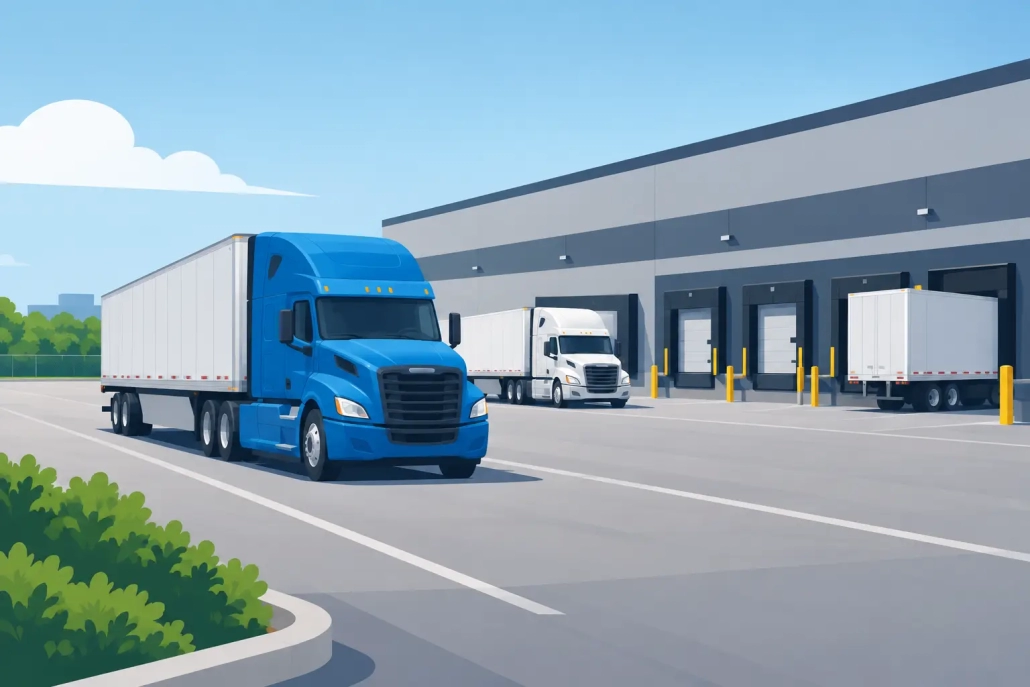
Commercial Loading Yard Case Study: Built for Traffic
A loading yard fence has a harder job than most commercial fencing. It must control access without slowing trucks, separate people from moving equipment, hold up around trailers and forklifts, and still give operators clear sightlines where they need them. This commercial loading yard case study looks at the planning and construction decisions behind a secure, practical perimeter for an active industrial site.
The project described here is representative of the type of commercial work that demands more than a standard fence layout. Every yard is different, but the same questions come up again and again: Where do trucks enter? Where do employees park? What needs to stay visible? What needs to stay out?
The Site: Heavy Traffic, Limited Room for Error
The property was an operating commercial yard with regular deliveries, material storage, employee traffic, and large vehicles moving in and out throughout the day. The owner needed a defined perimeter and controlled entry points, but the fence could not create blind corners, reduce turning room, or interfere with the daily flow of the business.
That is the key difference between a loading yard and a quiet storage lot. A fence line may look straightforward on a drawing, yet the real site has trailer swing, loading zones, overhead clearances, drainage routes, existing concrete, utility markings, and uneven ground to deal with. If the layout ignores any of those conditions, the problem shows up after installation, when it is costly and disruptive to fix.
The goal was clear: build a commercial fence system that improved security and traffic control while keeping the yard functional from the first day.
Start With the Yard Flow, Not the Fence Material
Chain link was the practical choice for the main perimeter. It provides a durable boundary, keeps sightlines open, and works well around industrial properties where security, maintenance, and visibility all matter. But material selection was only one part of the job.
Before setting posts, the site needed to be reviewed as a working yard. Vehicle entry and exit paths were measured. Areas used for truck staging were kept clear. Gate locations were planned around the actual approach and turning movement of larger vehicles, not just the shortest distance between two fence corners.
This step protects the investment. A gate that is too narrow may force drivers to make difficult turns. A gate set too close to a building, curb, or parked equipment can become a daily bottleneck. On the other hand, an oversized opening in the wrong location can create a security gap and leave too much of the site exposed.
For this type of project, access design depends on the operation. A contractor yard with frequent semitruck deliveries needs different openings than a service business with smaller fleet vehicles. The best layout is the one that fits the work being done on the property.
Separating Vehicle and Pedestrian Access
One of the most useful decisions on the site was keeping pedestrian access separate from the main vehicle gate. Employees and visitors had a designated walk-through entry, while trucks and work vehicles used the larger gate opening.
That separation helps reduce unnecessary interaction between people on foot and moving equipment. It also makes access easier to manage. A pedestrian gate can be positioned where staff naturally enter the property, while the vehicle gate remains focused on trucks, trailers, and daily deliveries.
A fence does not replace safe operating procedures, but it can support them. Clearly defined access points make it easier for property managers to direct traffic, control visitors, and keep restricted yard areas restricted.
Building Around Concrete, Grade Changes, and Existing Conditions
Commercial sites rarely offer perfect digging conditions. This yard included hard surfaces and areas where the fence line had to work around existing pavement and changing grade. That meant the installation could not rely on a one-size-fits-all approach.
Where posts needed to be installed through concrete, core drilling or concrete drilling provided a secure, accurate foundation. In other areas, post holes could be excavated and set in concrete. Each section was evaluated based on the ground conditions, the fence height, gate loads, and how the space would be used.
Gate posts received extra attention. They carry more stress than standard line posts, especially where a large commercial gate is opened repeatedly or exposed to wind. A sagging or dragging gate is not just frustrating. It can delay deliveries, create a security issue, and lead to unnecessary repairs.
The grade also mattered. A fence that follows the ground too closely may leave gaps underneath in some locations. A fence that is stepped too aggressively can look unfinished and create weak points along the bottom. The right approach depends on the slope, drainage, security requirements, and whether the yard needs to keep people, animals, or loose materials from moving under the fence.
Commercial Loading Yard Case Study: Choosing the Right Gates
For the main entrance, the gate needed to provide a wide, reliable opening without taking up valuable yard space. The right gate style depends on available room and operating habits.
A swing gate can be a strong option when there is enough clear space inside the property for the leaves to open fully. It is simple, durable, and well suited to many commercial entrances. A slide gate can make more sense where a swinging gate would interfere with parked vehicles, loading areas, or building access.
The project also required the gate to be easy for authorized staff to operate while remaining secure after hours. Depending on the property, that may mean a manual latch, lockable drop rods, a keypad, an access control system, or preparation for future automation. The right level of access control should match the risk and traffic volume. Not every loading yard needs a powered gate, but every loading yard needs a gate that closes securely and performs consistently.
Clearance at the entrance was just as important as the gate itself. Posts, hinges, latches, and protective bollards must be positioned so that a trailer does not clip them on a tight turn. A few inches on paper can make a major difference when a long vehicle is backing into a busy yard.
Security Without Turning the Yard Into a Blind Spot
Commercial clients often ask whether a taller, more private fence is automatically more secure. Sometimes it is. Often, it is not the best answer for a loading yard.
Chain link fencing provides visibility across the property line. That can help staff see activity near gates, storage areas, and parking zones. It also allows a property owner to keep an eye on the perimeter without creating hidden areas behind solid panels.
Where additional security is needed, the system can be upgraded with heavier framework, tighter mesh, privacy screening in select areas, or specialized top treatments where appropriate. The right choice should be based on what the business stores, when the yard is occupied, nearby public access, and the level of risk.
There is a trade-off. Privacy screening can block views into a storage area, but it can also increase wind load and reduce visibility for drivers. Taller fencing can discourage climbing, but it may require more substantial posts and careful review of local requirements. Good commercial fencing is not about adding every possible feature. It is about building the right system for the property.
Installation Planning Kept the Business Moving
For an active yard, installation timing matters almost as much as the finished fence. Closing off the main entrance for an entire workday may not be realistic. The work needs to be organized in phases so the business can continue receiving deliveries and moving equipment safely.
On a project like this, the crew coordinates access before work begins. Materials are staged where they will not block traffic. Fence sections are installed in a sequence that maintains a usable route into the yard whenever possible. Gate work is planned carefully because the transition from an open entrance to a secured entrance needs to happen with minimal disruption.
Site communication is part of the craftsmanship. Property managers need to know when areas will be inaccessible, where vehicles should be redirected, and when gate hardware will be installed. A well-built fence should not come at the cost of a chaotic worksite.
What Made the Project Work
The finished fence gave the yard a clear boundary, controlled access points, and a layout built around its daily operation. More importantly, it addressed the practical issues that are easy to miss when commercial fencing is treated as a simple material purchase.
The value came from matching the fence, posts, gates, and installation method to the site. Heavy-duty areas were built for the demands placed on them. Access points were designed for real vehicle movement. Concrete and grade conditions were handled with the right equipment rather than shortcuts.
For commercial property owners across Vancouver Island, that is the standard worth looking for. Vancouver Island Fence Company approaches complex sites with the same mindset: assess the conditions, plan the details, and build a fence that works as hard as the property does.
If your loading yard has tight access, difficult ground, concrete drilling requirements, or a gate that no longer fits the way your business operates, start with a site-specific plan. The right fence should make the day-to-day work easier, safer, and more controlled.

