
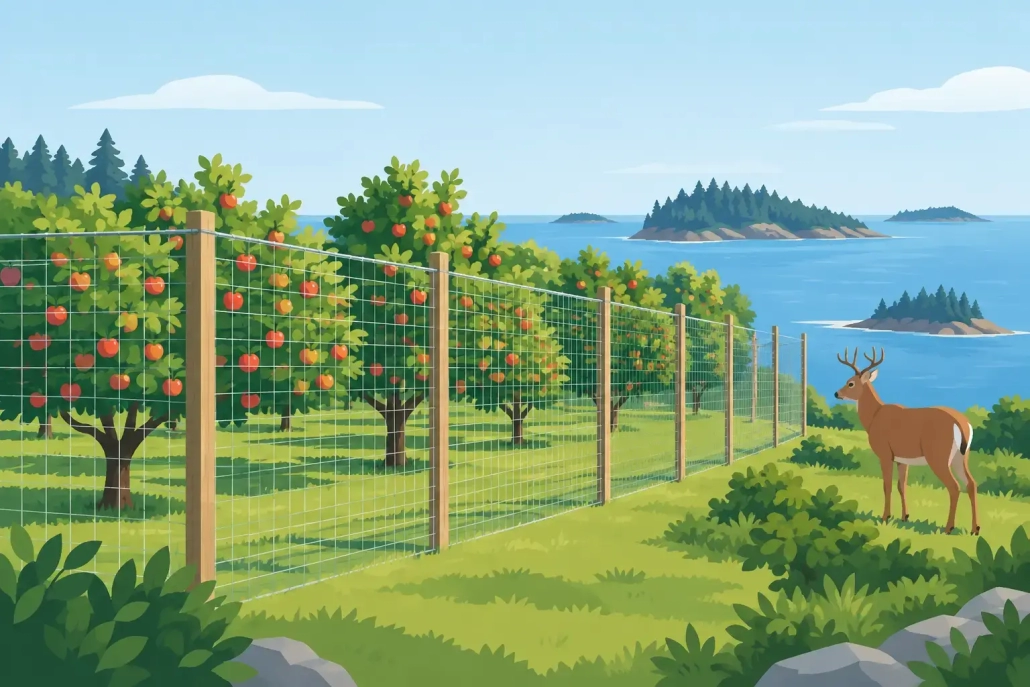
A Deer Barrier Orchard Example for Island Acreages
A few deer can strip the tender growth from young apple, pear, cherry, and plum trees in a single night. A well-planned deer barrier orchard example shows why individual tree guards are rarely enough once an orchard has more than a handful of trees. The dependable solution is a perimeter fence designed around deer behavior, the property layout, and the access you need to maintain the orchard.
For Vancouver Island acreage owners, the goal is not simply to put wire around trees. It is to build a fence that deer cannot jump, push through, or find their way around – and one that will keep working through wet weather, uneven ground, and regular gate use.
Deer Barrier Orchard Example: A Practical Layout
Consider a small orchard with 20 to 30 fruit trees on a rural residential property. The planting area measures roughly 100 by 150 feet, with an existing driveway along one side and a shallow slope at the back. Deer travel through the property from a wooded area behind the orchard, while the homeowner needs room for a compact tractor, wheelbarrow, pruning equipment, and harvest access.
A practical fence layout places the barrier around the entire orchard, not directly beside each row of trees. Allowing a clear working strip inside the fence makes mowing, pruning, irrigation repairs, and harvesting far easier. It also keeps low branches and new growth away from the mesh, reducing the chance that deer can browse through the fence.
In this example, the fence is set 10 to 15 feet beyond the outermost trees where space allows. The layout follows the natural grade rather than forcing perfectly square lines across a slope. A wider double gate faces the driveway for equipment access, while a separate walk-through gate gives the homeowner a convenient daily entrance. This simple decision prevents the main gate from being opened constantly, which is one of the most common weak points in a deer fence system.
Height Is the First Design Decision
Deer fencing needs height. An adult deer can clear a fence that looks substantial from the ground, especially when it is motivated by fruit, tender shoots, or a familiar feeding route. For most enclosed orchards, an 8-foot fence is the practical starting point. In areas with strong deer pressure, open approach paths, or heavy snowfall, going higher may be worth the added material and installation cost.
A lower fence can work in certain situations, but it depends on the site. A smaller, highly visible enclosed garden near an active home may see less pressure than an orchard bordering forest or undeveloped land. Sloping ground also changes the calculation. A fence that measures 8 feet from the uphill side may be significantly easier to jump from a raised area outside the fence line.
Fence height alone is not the full answer. Deer are less likely to attempt a jump when the top line is consistent, the fence is tight, and there is no easy landing area created by stacked materials, raised soil, or brush piles. Keep firewood, compost bins, equipment, and pruning debris away from the outside of the enclosure.
Choosing the Right Mesh and Post System
For an orchard barrier, high-tensile deer mesh is often a strong choice because it provides height without the heavy visual appearance of a solid privacy fence. The mesh should be durable enough for long-term outdoor exposure and installed under proper tension. Loose mesh can sag over time, create gaps at the bottom, and make the whole installation look unfinished.
Post selection depends on the fence length, soil conditions, terrain, and gate locations. Wood posts, steel posts, or a combination of both can work well. What matters is that corner posts, end posts, and gate posts are built to carry the load. These are structural points, not places to cut corners.
A long run of tensioned mesh pulls hard on the corners. On a straightforward site, properly set posts and bracing may be all that is required. On rocky Vancouver Island properties, installation can involve difficult digging, concrete drilling, or jackhammer work before the first section of fencing goes up. A fence is only as reliable as the footing beneath it.
The bottom edge also deserves attention. Deer usually jump rather than dig, but gaps under a fence invite smaller animals into the orchard and can become larger as soil washes away. Where ground is uneven, the mesh should follow the grade closely. In problem areas, a ground wire, buried apron, or carefully placed fill can close openings without creating a tripping hazard.
Build Gates for How the Orchard Is Used
An orchard gate should be planned around real equipment, not guessed at after the fence is finished. If a riding mower, compact tractor, utility trailer, or delivery vehicle needs to enter, measure it and allow room for turns. A narrow gate may save money at installation, but it can make every future task harder.
For the example orchard, a 12-foot double gate gives equipment access from the driveway. A 4-foot walk-through gate is placed closer to the house so daily visits do not require opening the larger entrance. Both gates use firm posts, dependable latches, and mesh or wire treatment that matches the fence height. A deer fence with a low, loosely secured gate is an open invitation.
Gate placement matters as much as gate size. Avoid locating a gate at the lowest, muddiest point of the site if there is another option. Also consider snow, drainage, and the swing direction. A gate that drags in winter or catches on uneven ground is less likely to be closed properly.
Plan Around Terrain, Water, and Existing Features
Orchards are rarely built on perfectly level, empty ground. There may be drainage swales, large roots, rock outcrops, retaining walls, sheds, or mature trees near the planned fence line. These conditions do not prevent a good deer barrier, but they need to be addressed during the layout stage.
A fence crossing a ditch or seasonal drainage path needs enough clearance to let water move through while preventing animals from passing underneath. A fence installed beside mature trees may need adjusted post spacing to avoid major roots. When the line meets a retaining wall, an existing chain link fence, or a building, the connection must be detailed so there is no bypass gap.
This is where professional site planning pays off. The quickest-looking route is not always the strongest route. Moving a fence line a few feet to reach stable ground or avoid repeated water damage can save repairs later.
Avoid These Common Orchard Fence Mistakes
The most expensive deer fence problems usually begin with a design shortcut. Installing a fence that is too short is the obvious one, but weak corners, poor gate hardware, and gaps at changes in grade cause just as much trouble. So does choosing materials based only on initial price.
Another mistake is fencing too tightly around the trees. It may reduce the total footage, but it leaves no room to work and puts branches close to the barrier. A practical enclosure should support the orchard as it grows. Young trees get larger, irrigation systems change, and equipment needs often expand over time.
Visibility is another trade-off. Black mesh can blend into a rural landscape better than bright metal fencing, while a more visible material can help people see the boundary around pathways or driveways. The best choice depends on how close the fence is to the home, road, neighboring properties, and outdoor living areas.
A Fence That Protects the Work Behind the Orchard
Fruit trees represent years of planting, pruning, watering, and patience. A deer barrier protects more than a crop. It protects the time and investment that go into establishing a productive orchard.
The right design starts with a site-specific layout, adequate height, solid structural posts, and gates that make the orchard easy to use every day. Vancouver Island Fence Company can assess difficult terrain and build a deer fence suited to the way your property works. A well-built barrier lets you focus on growing fruit instead of repairing damage after every visit from the herd.

