
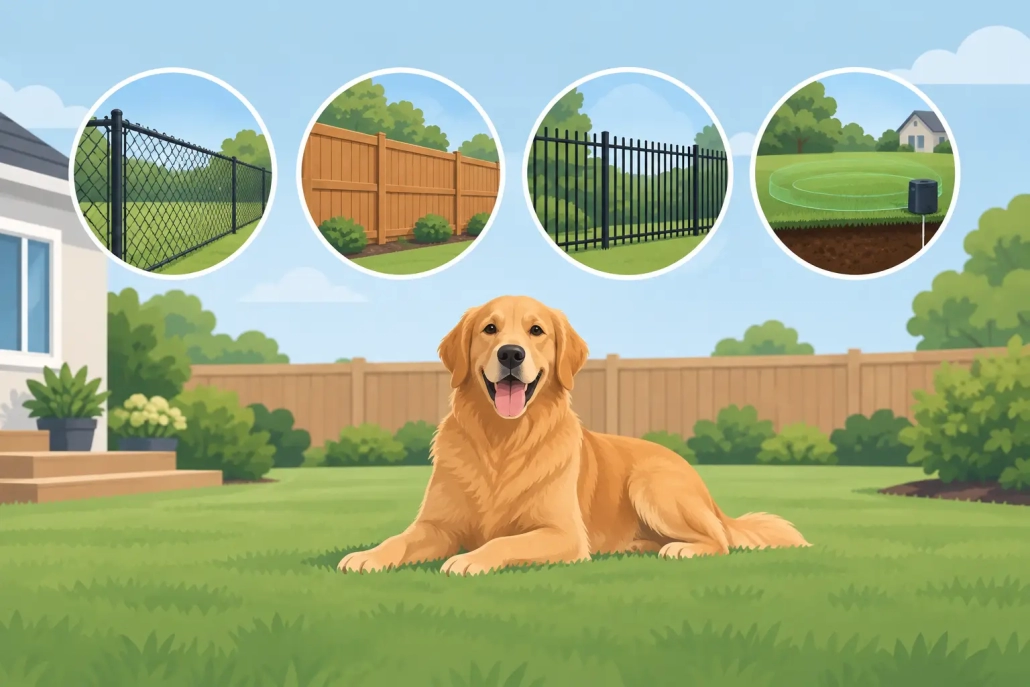
Best Dog Containment Fence Types for Your Yard
A dog that can clear a low gate, squeeze through wide wire, or dig beneath a corner does not need much time to get into trouble. The best dog containment fence types are the ones built around your dog’s size, habits, and energy level, while also fitting your property, budget, and the look you want around your home.
For Vancouver Island homeowners and acreage owners, the right answer is rarely one standard fence. A small dog in a compact Nanaimo yard has different needs than a large, athletic dog on a rural property near Courtenay or Campbell River. Start with the dog, then choose the material and construction details that will keep the enclosure secure for years.
What Makes a Dog Fence Actually Work?
Height matters, but it is only one part of dependable containment. A fence must also resist digging, climbing, chewing, pushing, and pressure at gates. It needs to be installed with solid posts, correctly tensioned materials where applicable, and a gate that latches reliably every time.
For many medium and large dogs, 6 feet is a practical starting height. Some dogs can be safely contained by a 4-foot fence, especially if they are small, calm, and not prone to jumping. Athletic breeds, strong dogs, or dogs with a history of escaping may need more height, a climb-resistant design, and added protection along the bottom edge.
Do not overlook the ground conditions. Vancouver Island properties often have slopes, rock, roots, drainage changes, and uneven grades. Gaps under a fence are an escape route, so the installation must follow the terrain closely or use appropriate grading, bottom rails, wire extensions, or buried barriers.
Best Dog Containment Fence Types Compared
Cedar Privacy Fencing
Cedar fencing is a strong choice for homeowners who want dependable dog containment and a finished residential look. Solid boards limit a dog’s view of passersby, neighboring pets, and wildlife. That can make a real difference for dogs that bark, charge the fence line, or become overstimulated by activity outside the yard.
A properly built cedar fence also provides privacy for the household and can define a backyard with warmth and character. For most large dogs, a 6-foot cedar fence is the preferred configuration. The key is solid construction: substantial posts, well-secured rails, tight boards, and no open space at the bottom.
Cedar is not the lowest-cost option, and it requires occasional maintenance to preserve its appearance. It is also not automatically dig-proof. If your dog digs, the bottom of the fence may need a buried wire apron, concrete edging, or another barrier suited to the site.
Chain Link Fencing
Chain link is one of the most practical containment choices for active dogs, large yards, side runs, commercial properties, and acreage. It is durable, visible, and generally more cost-effective than a full privacy fence over long distances. It also works well on properties where function matters more than screening.
For dogs, the mesh size and fence height must be chosen carefully. Smaller dogs need tighter mesh so they cannot push their head or body through the openings. A 5- or 6-foot chain link fence is often appropriate for larger or more energetic dogs. Heavy-duty framework is worth considering when the dog leans, jumps, or runs the perimeter regularly.
Chain link does not stop a dog from seeing beyond the property, so it may not suit reactive dogs without privacy slats or landscaping. It can also be climbed by determined dogs. In those cases, a smooth top rail, increased height, or an inward-facing extension may be necessary.
Black Vinyl-Coated Chain Link
Black vinyl-coated chain link delivers many of the same practical benefits as standard galvanized chain link with a softer, more residential appearance. The dark finish can blend into trees, gardens, and property lines better than bright metal, making it a popular choice when containment and curb appeal both matter.
It remains a strong option for dog runs and backyard boundaries, particularly where a cedar privacy fence would feel too enclosed or exceed the budget. Like standard chain link, it should be installed with the right height, tight fabric, secure terminal posts, and a quality gate latch.
Welded Wire Fencing
Welded wire fencing is often a good fit for rural and semi-rural properties where homeowners need to contain dogs without closing off long views. The wire grid can be selected in different opening sizes, allowing a better match for small dogs, puppies, and dogs that might otherwise slip through larger livestock-style wire.
This material works best when supported by solid posts and properly tensioned. Light wire stapled to a few wood posts may look adequate at first, but it can loosen under weather, animal pressure, and repeated use. A professionally planned welded wire fence is a far more dependable long-term solution.
Welded wire does not offer privacy and may be less suitable for dogs that fence-fight or react strongly to wildlife. It is, however, an efficient option for large enclosure areas, kennel runs, garden-side boundaries, and properties with an open-country setting.
Deer Fencing
Deer fencing is tall, lightweight, and designed primarily to keep deer out of gardens and landscaped areas. It can sometimes support dog containment, but it is not the first choice for every dog. A calm, smaller dog may respect it well, while a strong or high-drive dog can damage, climb, or push against lighter materials.
Where deer fencing makes sense is on a property that needs a tall, visually unobtrusive boundary and where the dog is supervised or naturally stays within limits. It can be especially useful around garden areas that need protection from both deer and dogs.
For reliable unsupervised containment, assess the strength of the material, post spacing, bottom fastening, and gate design. If your dog tests fences, choose a heavier-duty physical fence instead of relying on a lightweight barrier.
Ornamental Metal Fencing
Ornamental fencing offers a clean, upscale appearance and lasting strength. It is a good option for front yards, pool areas, entry features, and properties where the fence is part of the overall exterior design. The rigid structure stands up well to dogs that lean or jump against it.
The main consideration is spacing between pickets. Small dogs can slip through wide openings, while climbing dogs may use horizontal rails as footholds. A suitable ornamental dog fence uses close picket spacing, adequate height, and a gate with a self-closing or secure latching system where needed.
Ornamental fencing typically costs more than chain link or basic wire, but it provides a polished finish and can be built to complement a home’s architecture without sacrificing containment.
Electric or Invisible Dog Fences
Underground electronic systems are sometimes marketed as an easy containment solution, but they should be approached carefully. They do not create a physical barrier to wildlife, other dogs, people, or traffic. A dog may also run through the boundary when excited, then hesitate to return because it expects another correction.
These systems can be useful as an added training tool within a secure physical enclosure, but they are not a substitute for a properly built fence when safety is the priority. They are also unsuitable for many anxious, reactive, or high-prey-drive dogs.
Fence Details That Prevent Common Escapes
The best material can still fail if the details are overlooked. Digging dogs need protection below grade, which may include burying wire mesh, extending material into the ground, or adding a ground-level barrier along likely digging zones. Dogs that jump need sufficient height and should not have nearby sheds, planters, firewood, or furniture that create a launch point.
Gate areas deserve special attention. A sagging gate, loose latch, or gap at the hinge side is often the weak point in an otherwise well-built enclosure. For properties with children, visitors, or service access, consider a latch that cannot be easily bumped open and a self-closing gate where appropriate.
If your property has rock, steep grade changes, or difficult access, installation experience matters as much as the fence material. Proper post setting, concrete work, drilling, and site preparation keep the finished fence secure instead of leaving shortcuts that a determined dog will find.
Choosing the Right Fence for Your Property
A cedar privacy fence is often the best fit for a backyard dog that benefits from fewer visual triggers. Chain link or welded wire is usually more practical for large runs, acreage, and long property lines. Ornamental fencing works well where appearance is a priority, while deer fencing may be appropriate for limited, lower-pressure applications.
Before committing, consider your dog’s mature size, jumping ability, digging behavior, and reaction to distractions. Then look at the property itself: terrain, drainage, sightlines, local requirements, gate access, and whether the fence needs to do double duty for privacy, security, or deer control.
Vancouver Island Fence Company can help match those details to a fence built for the way your property is actually used. A well-planned enclosure gives your dog room to move, gives you confidence at the gate, and lets everyone enjoy the yard without constantly watching the perimeter.

