
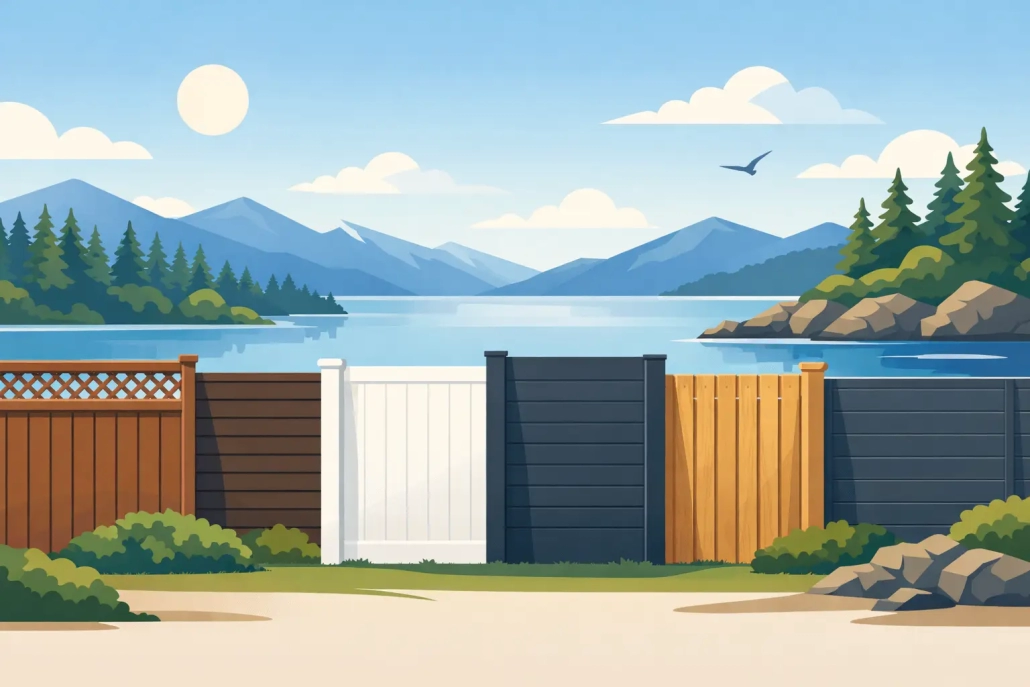
8 Best Fence Styles for Privacy on Vancouver Island
A privacy fence does more than block a neighbor’s view. It creates a usable backyard, defines the property line, helps contain children and pets, and can make a busy street feel farther away. The best fence styles for privacy depend on the layout of your lot, local weather exposure, maintenance expectations, and the look you want around your home or business.
On Vancouver Island, a fence also needs to stand up to prolonged rain, damp ground, wind exposure, and shifting terrain. A good privacy fence starts with the right materials, but it lasts because the posts, footings, gates, and drainage are handled properly from day one.
Best Fence Styles for Privacy: Start With How You Use the Space
Before choosing a style, consider where privacy matters most. A solid fence along a patio or hot tub area may be more useful than enclosing every side of the yard at maximum height. Homes on corner lots, sloped properties, rural acreage, and properties near trails or commercial areas often need a more custom approach.
Height is also a practical factor. A six-foot fence is a common choice for residential backyards, but local rules, lot conditions, and neighbor relationships can affect what is appropriate. If you need more screening without making the yard feel boxed in, a stepped design, decorative top section, or strategically placed privacy panels can be a better answer than simply building higher.
1. Solid Cedar Privacy Fencing
For many Vancouver Island properties, cedar is the classic privacy-fence choice. It has a warm, natural appearance that fits established neighborhoods, coastal homes, gardens, and wooded lots. A solid cedar fence can be built in several patterns, from clean vertical boards to horizontal designs and framed panel sections.
Cedar holds up well outdoors and can be left to weather naturally or finished to maintain a more consistent color. It is also easy to customize around grade changes, existing landscaping, retaining walls, and unusual property lines. For homeowners who want a fence that feels built for the property rather than pulled from a standard kit, cedar offers plenty of flexibility.
The trade-off is maintenance. Cedar is durable, but it is still wood. Regular inspection, cleaning, and occasional staining or sealing can help preserve its appearance and extend its service life. Proper post installation matters just as much as the boards themselves, especially where wet soil or difficult digging conditions are involved.
Vertical Board Cedar Fences
Vertical-board fencing is a dependable, traditional privacy style. Boards run upright with either a tight solid layout or a board-on-board pattern that overlaps the boards. Board-on-board construction is especially useful where boards may shrink slightly over time, because the overlap helps prevent visible gaps.
This style suits most residential yards and can be finished with a flat top, lattice top, cap rail, or decorative trim. It is straightforward, attractive, and easy to repair if a single board is damaged.
Horizontal Cedar Fences
Horizontal cedar fencing gives a property a more modern, architectural look. Long, level boards can make a smaller backyard appear wider and work well with contemporary homes, patios, and landscaped outdoor spaces.
This style requires careful layout and strong framing. On sloped ground, the lines need to be planned so the finished fence looks intentional rather than uneven. It is a good example of a design where experienced installation makes a visible difference.
2. Louvered or Semi-Private Cedar Panels
Some yards need privacy without completely closing off light or airflow. Louvered panels use angled boards that limit direct sightlines while allowing air to move through. They are often used around decks, outdoor kitchens, seating areas, garbage storage, or as a screen between closely spaced homes.
A semi-private design is not the right choice where total visual separation is the goal. However, it can make a sheltered outdoor area feel more open than a solid wall of fencing. It also reduces the wind load that can put extra pressure on posts and panels in exposed locations.
3. Privacy Fences With Decorative Lattice Tops
A solid lower section with lattice across the top is a practical compromise for homeowners who want screening without an overly heavy appearance. The solid portion protects the main sightlines, while the lattice adds detail, lets in some light, and softens the fence line.
This style works particularly well in gardens and established neighborhoods. Climbing plants can be trained along the lattice, although vegetation should be maintained so moisture and debris do not stay trapped against the wood. Lattice tops are not a substitute for a taller solid fence when complete privacy is needed, but they can improve the look and function of a standard fence line.
4. Vinyl Privacy Fencing
Vinyl privacy fencing has a clean, uniform appearance and requires less routine maintenance than wood. It will not need staining, and it does not rot in the way untreated or poorly maintained wood can. For property owners who prefer a consistent white, gray, tan, or neutral fence with minimal upkeep, vinyl can be a practical option.
The limitations are design flexibility and repair considerations. Vinyl systems come in set panel sizes and profiles, so adapting them to irregular grades or custom layouts may take more planning. A damaged section may also need replacement rather than a simple board repair. Quality materials and solid installation are essential because lower-grade vinyl can become brittle or look weathered over time.
5. Composite Privacy Fencing
Composite fencing is another low-maintenance option. It is designed to provide the appearance of wood without the same staining and sealing requirements. Many composite systems are available in muted natural tones that suit modern residential settings.
Composite is often chosen for long-term convenience, but it usually comes with a higher initial cost than a standard cedar fence. It can also expand and contract with temperature changes, so the framing and spacing need to follow the manufacturer’s requirements. For a homeowner who wants a refined appearance and does not want regular wood-fence maintenance, the added upfront investment may make sense.
6. Chain Link Fencing With Privacy Slats or Screens
Chain link is usually associated with security and containment, but it can provide privacy when combined with slats, privacy fabric, or planted screening. This approach can be useful for commercial properties, dog runs, service areas, sports courts, and larger lots where a solid wood fence may not be the best fit.
Privacy slats provide a more permanent, orderly look than fabric, while mesh screens can be installed quickly and are useful for temporary or targeted screening. Neither option offers the same finished residential appearance as cedar or vinyl, and strong wind can put pressure on fabric screens. Still, chain link with privacy additions is a cost-conscious solution when function, durability, and secure boundaries come first.
7. Mixed-Material Privacy Fences
A mixed-material fence can solve site-specific problems while creating a distinctive look. For example, a property may use ornamental metal fencing at the front for curb appeal, then transition to solid cedar along the side and rear yard for privacy. A commercial site might use chain link along a long boundary and a cedar screen around customer-facing areas.
This approach gives each part of the property the right level of security, visibility, and screening. It can also keep the budget focused on the areas where privacy has the greatest value. The key is making sure the transitions look planned and the gate locations, post sizes, and elevations work together.
8. Custom Privacy Screens for Problem Areas
Not every privacy issue calls for a full perimeter fence. A custom screen can block an overlooking window, separate a shared driveway, hide utility equipment, or create a private patio corner. These smaller builds are often the right answer for tight urban lots in Nanaimo, Courtenay, Comox, Parksville, or Campbell River.
Custom screens can be built from cedar, lattice, horizontal boards, metal accents, or a combination of materials. They can also be integrated with a gate, pergola, retaining wall, or deck. When the site is rocky, steep, or difficult to access, professional equipment and proper footing work become especially important.
Do Not Overlook Posts, Gates, and Drainage
The boards are what people see, but the structure is what determines whether the fence stays straight. Posts should be sized for the fence height and wind exposure, installed at the right depth, and supported with properly placed concrete where needed. On Vancouver Island, wet ground and difficult subsurface conditions can make this work more demanding than it looks.
Gates deserve the same attention. A privacy gate is large and heavy, and a poorly supported gate can sag, drag, or stop latching properly. Strong posts, quality hardware, and correct alignment prevent many of the most common fence problems.
Vancouver Island Fence Company has been building fencing locally since 1999, including projects that require jackhammering, concrete drilling, and solutions for challenging sites. If your property has a slope, rock, limited access, or an unusual layout, those details should be addressed during the estimate, not after the build begins.
The right privacy fence should make the space behind it more useful every day. Choose the style that fits your property, invest in the structure beneath it, and get a clear plan before the first post goes into the ground.

