
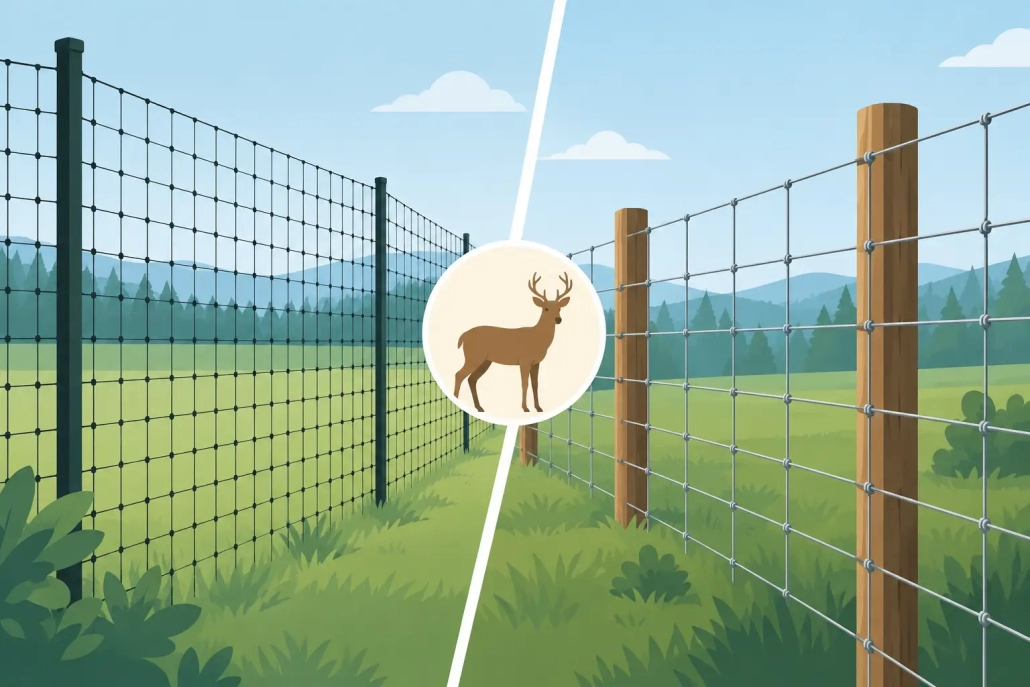
Deer Netting Versus Wire Fencing Compared
A vegetable garden can be stripped overnight, while a young cedar hedge may take years to recover from repeated deer browsing. For Vancouver Island property owners, the choice between deer netting versus wire fencing comes down to more than keeping wildlife out. The right material has to suit the terrain, the size of the protected area, the expected pressure from deer, and how permanent you need the fence to be.
Both options can work well when they are properly planned and installed. They serve different purposes, however. Deer netting is often the practical choice for large garden areas and properties where a low-visibility barrier matters. Wire fencing is the stronger, more permanent option when you need reliable protection, defined boundaries, or a fence that can handle more than deer.
Deer Netting Versus Wire Fencing: The Main Difference
Deer netting is typically a lightweight mesh made from polypropylene or a similar synthetic material. It is designed to create a physical barrier that deer cannot easily see from a distance but cannot pass through once it is installed at the correct height and tension. It is commonly used around gardens, orchards, landscaping, and seasonal growing areas.
Wire fencing uses galvanized steel wire in a woven, welded, or fixed-knot pattern. It can be built as a deer fence, field fence, chain link-style enclosure, or custom wire system depending on the property and purpose. A properly installed wire fence is more rigid, more durable, and better suited to long-term use.
The difference is straightforward: deer netting is primarily a wildlife-exclusion product, while wire fencing is a structural fence system that can provide wildlife control along with boundary definition, security, and containment.
When Deer Netting Makes Sense
Deer netting is a good fit when the main goal is protecting plants without making the property feel enclosed. It is especially useful around food gardens, berry patches, small orchards, newly planted trees, and landscape beds where deer are the only serious concern.
Its low visual impact is one of its strongest advantages. From a distance, quality black deer netting tends to blend into the background better than metal fencing. That matters for homeowners who want protection around a garden but do not want to interrupt views or create a heavy-looking perimeter.
Netting can also be a cost-conscious solution for a large area, provided the site is relatively straightforward. On open, level ground with accessible post locations, a deer-netting installation may require less material cost than a comparable steel-wire fence. It can also be adapted for seasonal use in certain garden applications.
That said, lightweight does not mean maintenance-free. Deer netting must be pulled tight, securely fastened, and kept close to the ground. A loose bottom edge gives deer a point to push under, and sagging mesh can become a problem during wind, snow load, or vegetation growth. Branches, fallen limbs, and lawn equipment can also damage the material.
Height Still Matters
A short fence will not reliably stop deer, regardless of material. Deer are capable jumpers, particularly when they can see a clear landing area on the other side. Most deer-exclusion fencing needs significant height, often around 7 to 8 feet depending on local deer pressure, site conditions, and the layout of the enclosed area.
Corners, slopes, and gates deserve just as much attention as fence height. Deer tend to test the weak point rather than challenge the strongest section. A fence that looks complete but has an easy gap beneath a gate or along uneven ground can quickly become ineffective.
Where Wire Fencing Has the Advantage
Wire fencing is the better choice when the fence needs to do more work. It offers greater resistance to impact, weather, falling debris, and everyday wear. For acreage properties, commercial sites, rural boundaries, and permanent garden enclosures, wire is often the more dependable long-term investment.
A steel wire system can be selected for the specific application. Smaller openings help discourage smaller animals from entering. Heavier-gauge materials provide more strength where pressure is higher. Fixed-knot and woven-wire products can handle challenging conditions better than lighter welded mesh, while chain link may be appropriate where security and durability are priorities.
Wire fencing also holds its shape well. Once posts are properly set and the wire is tensioned, the fence provides a clear, sturdy line around the property. That is valuable on sites where deer are not the only issue. Dogs, livestock, unauthorized access, and general property definition can all factor into the decision.
The trade-off is visibility. Even dark-coated wire is more noticeable than deer netting, especially at close range. It also usually carries a higher upfront cost because it requires stronger posts, more hardware, and more labor to install correctly. Over time, however, its durability can make it the more economical option for a permanent installation.
Compare Strength, Lifespan, and Maintenance
For pure strength, wire fencing wins. It is less likely to tear when a branch falls against it, when an animal presses into it, or when the fence encounters the normal demands of an active property. Galvanized and coated wire products are built to resist corrosion, although coastal exposure, wet ground, and damaged coatings can shorten their service life.
Deer netting can last well when it is quality material, protected from abrasion, and installed with proper support. But it is more vulnerable to punctures, UV aging, and accidental damage. Once a small tear appears, it should be repaired quickly. A deer will often find and exploit an opening that looks minor from the outside.
Maintenance for both systems starts with regular inspection. Walk the fence line after storms, high winds, or heavy snow. Clear vegetation that is pulling on the fence. Check gates, bottom edges, corners, and transition points where the fence meets a building or retaining wall.
Wire fencing generally asks for less frequent repair, but repairs can be more involved when they are needed. Deer netting may need more regular attention, but small issues can often be addressed quickly before they turn into a larger breach.
Installation Is Where Performance Is Won or Lost
A fence is only as effective as its posts, bracing, gates, and ground contact. This is especially true on Vancouver Island, where many properties have uneven grades, rock, mature trees, wet areas, and limited equipment access.
For deer netting, the support structure needs to maintain consistent tension without overstressing the mesh. Posts must be placed and braced to prevent the fence from sagging over time. The bottom edge needs to follow the grade closely, whether that means trenching, pinning, or using another method to eliminate access underneath.
For wire fencing, post depth, spacing, corner construction, and tensioning all matter. A taller wire fence creates more leverage on the posts, so weak corners and shallow post holes can lead to movement and sagging. Rocky ground may require specialized equipment, concrete drilling, or jackhammering to establish secure post locations.
Gates should be planned from the beginning, not added as an afterthought. Consider how wide an opening needs to be for a wheelbarrow, mower, truck, trailer, or maintenance equipment. A gate that is convenient to use is more likely to stay closed, which is one of the simplest ways to keep a deer fence effective.
Choose Based on the Job, Not Just the Material Price
The lowest initial price is not always the lowest ownership cost. If you need to protect a seasonal vegetable garden and want the least visible barrier possible, deer netting may be exactly the right tool. Paying for a heavier wire system in that case may not add meaningful value.
If you are fencing an acreage, protecting a large orchard, enclosing a commercial landscape, or creating a permanent boundary, wire fencing is often worth the additional investment. It is better equipped to handle long-term use and gives you more options if the property’s needs change later.
A hybrid approach can also make sense. A property may use wire fencing along exposed boundaries and deer netting around a more discreet garden area. The best layout depends on deer traffic, access points, slope, visibility, and the other animals or security concerns involved.
Vancouver Island Fence Company helps property owners choose and install fencing that fits the site rather than forcing every project into the same design. From difficult ground conditions to custom gates and tall deer barriers, experienced installation protects the value of the materials you select.
Before committing to either option, walk your property with the fence route in mind. Look for the low spots, the gate locations, the rock, and the places deer already travel. A well-built fence starts with that practical assessment, and it gives your garden, landscaping, or working property a far better chance of staying protected for years.

