
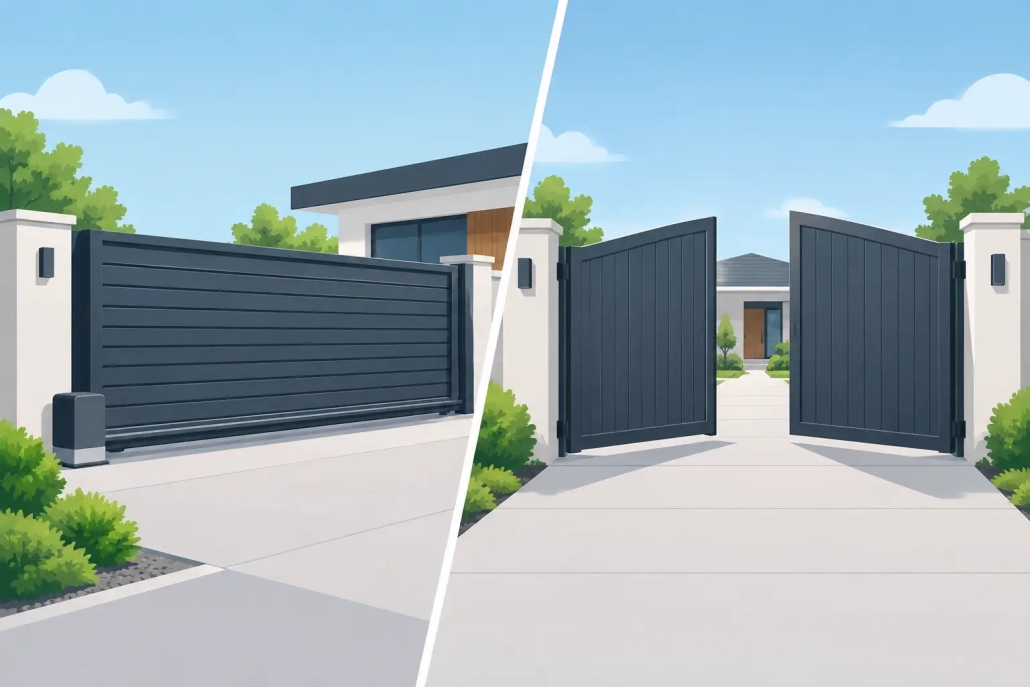
Sliding Versus Swing Gates: Which Is Right?
A gate can be the hardest-working part of a fence line. It needs to open reliably in rain, wind, frost, gravel, and daily traffic while still looking right at the front of your property. When comparing sliding versus swing gates, the best choice usually comes down to available space, ground conditions, traffic patterns, and how you plan to use the entrance.
For a driveway gate at a Nanaimo home, a rural property near Parksville, or a commercial entrance in Campbell River, there is no one-size-fits-all answer. A well-built gate starts with the site. The right design will operate properly, suit the fence system, and avoid creating a maintenance problem where you need dependable access.
Sliding Versus Swing Gates: The Main Difference
A swing gate opens inward or outward on hinges, much like a large door. It can be a single panel or a pair of panels that meet in the middle. Swing gates are familiar, adaptable, and often a strong fit for residential driveways with enough clear room behind the gate line.
A sliding gate moves sideways along the fence line. Depending on the design, it may roll on a track, use cantilever hardware that keeps the gate above the ground, or operate as a custom sliding system for a difficult site. Sliding gates are commonly chosen when a driveway slopes, space behind the entrance is limited, or vehicles need to pull close to the gate before it opens.
Both styles can be built in chain link, ornamental steel, cedar-framed designs, wire fencing, and other custom combinations. The opening method is only one part of the decision. The posts, footings, hardware, latch system, and site preparation matter just as much.
When a Swing Gate Makes Sense
Swing gates are often the straightforward choice for residential properties. They offer a traditional appearance, work well with many fence styles, and can be designed to make a driveway feel more finished without overpowering the property.
You have level, clear space inside the entrance
A swing gate needs room to travel. For an inward-swinging gate, the driveway needs to stay clear behind the gate line. Parked vehicles, retaining walls, landscaping, and uneven ground can all interfere with its movement. Outward-swinging gates may be possible in some situations, but they cannot create a hazard by opening into a public road, sidewalk, or shared access area.
On a relatively level driveway with good clearance, swing gates are simple and effective. A double swing gate can cover a wider opening while reducing the weight carried by each leaf.
Appearance is a major priority
For cedar fencing, ornamental fencing, and decorative front entrances, swing gates can provide a clean, balanced look. They work especially well when the gate is visible from the street and intended to complement the architecture of the home.
The visual details still need practical planning. A large solid cedar gate catches more wind than an open ornamental or chain link gate. Proper posts and hardware are essential, particularly on exposed Vancouver Island sites where wind and wet weather are part of the job.
Your access needs are occasional or moderate
A manual swing gate is a practical option for many homes, side yards, garden areas, and acreage entrances that do not see constant traffic. It can also be automated when the layout and electrical planning support it.
For a long driveway, consider where a vehicle will wait while the gate opens. You do not want a car stopped in the road or blocking a shared lane. Setting the gate back from the road may solve that issue, but it requires enough room on the property.
When a Sliding Gate Is the Better Fit
Sliding gates earn their place where swing gates run out of room. They are often the more functional choice for commercial properties, narrow entrances, sloped driveways, and locations where frequent vehicle traffic demands a controlled opening.
Your driveway slopes near the gate
Grade is one of the biggest reasons to choose a sliding gate. A swing gate must move across the surface below it, so a rising driveway can limit clearance or cause the bottom of the gate to drag. Regrading may be possible, but it can add unnecessary cost and site disruption.
A properly designed sliding gate avoids that arc of movement. Cantilever sliding gates are particularly useful on uneven ground because the gate travels above the driveway rather than on a ground track. That can make them a strong option for rural properties, commercial access points, and sites with challenging drainage.
Space behind the gate is limited
If the driveway ends at a garage, parking pad, retaining wall, or building, there may be no practical room for a swing gate to open. A sliding gate moves parallel to the fence instead, keeping the driveway clear.
The trade-off is that a sliding gate needs room along the fence line. A cantilever system typically requires a runback area longer than the clear opening, while a tracked gate needs a clear route for the wheel and track. Before choosing this style, measure more than the driveway width. The available side space is just as important.
You need frequent, reliable access
Sliding gates are common at commercial yards, strata properties, industrial sites, and active rural entrances because they work well with automation and repeated use. A vehicle can pull up close to a sliding gate without blocking its path, which is useful where space is tight.
For properties that need controlled access, the gate can be planned around keypads, remotes, intercoms, safety loops, and other entry systems. These details should be considered early. Installing a gate first and trying to add access controls later can create avoidable changes to posts, wiring, and concrete work.
Site Conditions Matter More Than Most People Expect
A gate that looks simple on paper can become a technical installation once the site is assessed. Vancouver Island properties often involve rocky ground, uneven grades, drainage concerns, exposed weather, or older fence lines that are not built to carry the load of a new gate.
Gate posts carry substantial force. A wide swing gate puts repeated leverage on hinge posts. A sliding gate requires accurately installed posts, guides, rollers, or cantilever hardware. In either case, shallow footings or undersized posts can lead to sagging, dragging, and latching problems.
This is where professional installation makes a noticeable difference. Concrete drilling, jackhammering, excavation, and careful layout may be necessary to build a gate that stays aligned. The goal is not simply to make it open on installation day. The goal is to make it operate properly after seasons of rain, use, and ground movement.
Drainage also deserves attention. A tracked sliding gate can collect gravel, leaves, ice, and debris if the route is not planned well. A swing gate can be affected by washouts or heaving ground below its path. The right solution depends on the property, not a standard drawing.
Security, Privacy, and Animal Control
The gate should perform the same job as the fence around it. For security, the design should limit easy access while providing dependable latching and a clear boundary. Chain link gates, ornamental gates, and steel-framed custom gates can all be built for controlled access, depending on the level of visibility and security required.
For privacy, a solid cedar gate can match a cedar fence and screen a driveway effectively. Keep in mind that solid panels are heavier and more affected by wind. A steel frame with well-built infill can provide the strength needed for a larger privacy gate.
For acreage and animal-control applications, the priority may be width, durability, and daily usability rather than decorative detail. Deer fencing, wire fencing, and farm-style access points often benefit from a gate layout that accommodates equipment, trailers, and service vehicles. A gate that is too narrow becomes a problem every time a delivery truck or tractor needs access.
Choosing the Right Gate for Your Property
Start with the driveway width, the slope at the entrance, and the clear space on both sides of the gate. Then consider how often the gate will be used, whether it will be automated, what type of vehicles need access, and how much wind exposure the location receives.
Choose a swing gate when you have level clearance behind the opening, want a classic look, and do not need constant vehicle access. Choose a sliding gate when grade, limited driveway depth, frequent traffic, or automation points toward a sideways-moving system.
Vancouver Island Fence Company designs and installs gates as part of complete fencing projects, including custom builds and difficult site work. A site visit allows the gate style, structure, hardware, and foundation work to be planned as one system instead of treated as an afterthought.
Before committing to a gate style, stand at the entrance and picture the busiest day your property will have: vehicles arriving, deliveries backing in, wind blowing, and the ground wet underfoot. Build for that day, and the gate will serve you well on all the ordinary ones.

