
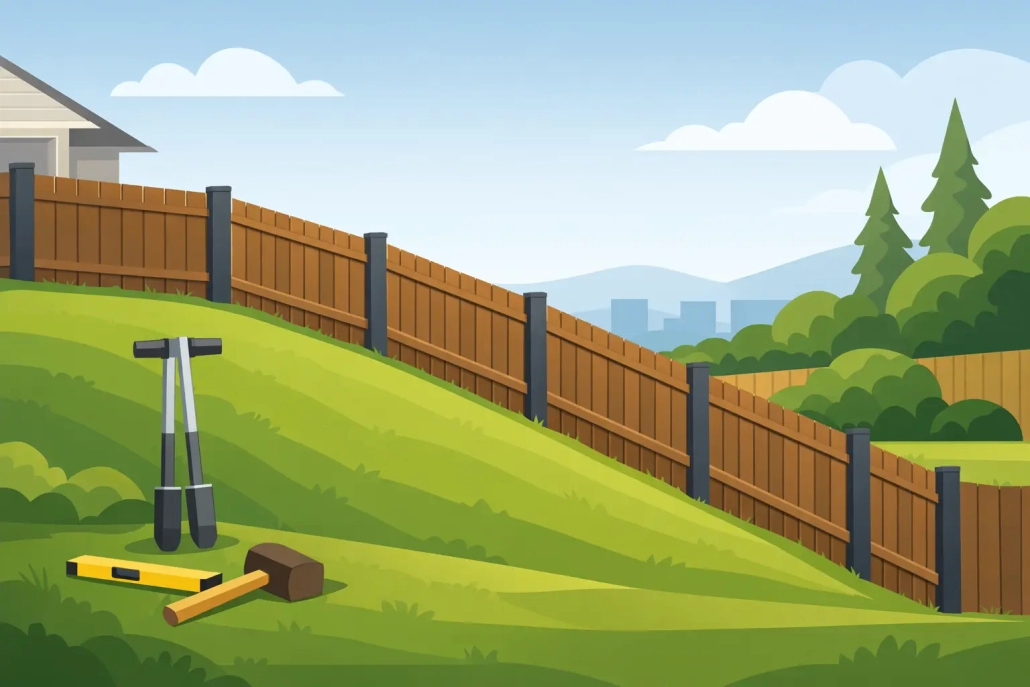
How to Fence a Sloped Yard That Stays Straight
A sloped yard can turn a straightforward fence project into a layout, drainage, and structural challenge. Knowing how to fence a sloped yard starts with one decision: should the fence follow the grade, or should it step down the hill in level sections? The right answer affects the finished look, privacy, cost, and long-term strength of the fence.
On Vancouver Island, slopes often come with wet ground, exposed rock, mature roots, and uneven access. A fence that looks good on installation day still needs to stand firm through winter rain, shifting soil, and years of use. That is why the planning work matters as much as the fence material itself.
Start With the Slope, Not the Fence Style
Before choosing cedar, chain link, ornamental steel, wire, or deer fencing, walk the proposed fence line from end to end. Look for changes in elevation, low areas where water collects, buried rock, retaining walls, trees, and places where equipment may have limited access.
A gentle, consistent slope gives you more options. A steep or irregular slope may require shorter fence runs, specially placed posts, or site preparation before installation begins. The goal is not simply to make the fence fit the hill. It is to create a fence line that is stable, functional, and intentional-looking from both sides.
Mark the property line carefully before any holes are dug. If there is uncertainty around a boundary, have it confirmed first. It is also wise to identify underground utilities and irrigation lines before setting posts. Correcting a layout error after concrete is poured is expensive and avoidable.
Drainage deserves the same attention. Water that runs down a hill can erode soil around posts or collect against the bottom of a solid privacy fence. In some locations, a small adjustment to post placement, grading, or clearance below the fence can prevent future trouble.
How to Fence a Sloped Yard: Choose Stepped or Racked
Most sloped-yard fencing uses one of two methods: stepping or racking. Both can be built well. The best choice depends on the fence material, the steepness of the grade, and what the fence needs to do.
Stepped fencing follows level sections
A stepped fence uses panels or rails that remain level, then drop down at each post as the ground falls away. From a distance, the fence has a stair-step appearance.
This is often the practical choice for cedar privacy fencing, especially where standard panels or horizontal rails are being used. It keeps boards plumb and rails level, which creates a clean, traditional finished appearance. It can also make installation easier on a sharp slope because each section is built as its own level run.
The trade-off is the gap that may appear below each stepped section. On a mild slope, the gap may be small enough to manage with grading, a rot board, or an adjusted bottom rail. On a steeper grade, the openings can become large enough for pets to pass through or for wildlife to enter. If containment or privacy at ground level is a priority, the layout needs more attention.
Stepped fencing can also use more material on a long hill because posts may need to be set closer together to keep each drop manageable. Still, for many wood fence projects, it is the strongest-looking and most reliable approach.
Racked fencing follows the contour of the ground
A racked fence, sometimes called a contoured fence, has rails and panels that angle with the slope. Instead of stepping down, the fence follows the grade in one continuous line.
Racking works especially well with chain link fencing, ornamental fencing, and some purpose-built wood systems. It can reduce gaps below the fence and creates a smoother look on gradual slopes. For dog runs, security fencing, and deer fencing, that close fit to the ground can be a major advantage.
Not every material can rack effectively. Standard prebuilt cedar panels are generally not designed to be forced into an angle. Trying to make them follow a steep grade can twist the frame, leave uneven board spacing, and shorten the life of the installation. A custom-built wood fence can allow more flexibility, but the degree of slope still has limits.
The steeper the grade, the harder it is to rack a fence without affecting panel proportions or post spacing. On a severe slope, stepping may be the better solution even if a racked fence initially seems more convenient.
Set Posts Deep Enough for the Site Conditions
Posts carry the load of the entire fence. On a slope, they work even harder because the fence is exposed to uneven soil pressure, runoff, and wind. A shallow post hole or undersized post may not show problems right away, but leaning and movement often appear after a wet season.
Post depth should be based on the fence height, soil conditions, material weight, and local site requirements. Privacy fences and gates need more support than a light wire fence. End posts, corner posts, and gate posts also take greater load and should be planned accordingly.
Concrete-set posts are common for many fence types, but concrete alone does not solve a poor hole or poor drainage condition. The hole must be properly sized, the post must be plumb in both directions, and the fence line must be laid out before concrete begins to set. On rocky sites, installation may require jackhammering, concrete drilling, or specialized equipment to create a secure foundation without damaging surrounding surfaces.
This is one area where professional experience makes a visible difference. A straight top line and consistent spacing are hard to achieve when every post location has a different elevation and soil condition.
Plan the Top Line for a Finished Look
A fence on a hill can look crooked even when it is structurally sound. The visual result depends heavily on the top line.
With a stepped fence, each section should be level and each step should feel deliberate. Keeping step heights consistent where possible helps the fence look clean rather than improvised. With a racked fence, the top rail should follow the grade smoothly without sudden changes in angle.
Do not assume the bottom of the fence must match the ground exactly. In fact, chasing every dip and bump can make the finished line look uneven. Minor grading, carefully placed fill, or controlled clearance may provide a better result than trying to fit every section tightly to rough terrain.
For cedar privacy fencing, consider the view from both sides. A well-built fence should look finished for the homeowner and the neighbor. On a sloped lot, rail placement, board length, cap details, and trim can all help make stepped sections look intentional.
Match the Fence Material to Its Job
The right fencing material depends on what you need the fence to accomplish. A backyard privacy fence has different demands than a commercial perimeter or acreage enclosure.
Cedar is a strong choice for privacy, curb appeal, and custom designs. It works particularly well in stepped layouts and can be built to suit changing grades. Proper post installation and quality construction are essential because solid wood fences carry significant wind load.
Chain link is practical for pets, security, sports areas, and commercial applications. It racks well on many slopes and can be fitted close to the ground. It is often a cost-effective solution where function matters more than visual screening.
Ornamental fencing offers a clean, durable appearance for residential and commercial properties. Many systems can follow moderate grades, although steep slopes may require stepped sections or custom planning.
Wire and deer fencing are common on larger properties where animal control is the priority. On sloped acreage, the fence needs enough tension, properly braced corners, and ground clearance that prevents animals from pushing underneath. Terrain changes can be substantial, so post spacing and bracing should be designed around the site rather than treated as a standard installation.
Do Not Overlook Gates and Transitions
Gates are often the most complicated part of fencing a slope. A gate needs clearance to swing, a level enough opening to operate properly, and posts that will not move under repeated use. Placing a gate directly on the steepest section of a hill usually creates unnecessary problems.
When possible, locate gates on a flatter section of the property. If the gate must sit on a slope, the opening and swing direction need to be planned early. A gate that drags on the ground or leaves a large gap below is frustrating from the start and difficult to correct later.
Transitions around retaining walls, driveways, stairs, and existing structures also require careful measurements. These are the places where custom fabrication and experienced installation matter most. A clean transition protects the function of the fence and keeps the project looking complete.
Know When a Sloped Yard Needs Professional Installation
A modest backyard slope may be manageable for an experienced DIY builder with the right tools. But a project becomes more demanding when there is rock, heavy clay, drainage issues, tall privacy fencing, long runs, commercial security requirements, or difficult access.
Professional installation is especially worthwhile when the fence must be straight, secure, and built around challenging terrain. Vancouver Island Fence Company has handled residential, commercial, and rural fence projects since 1999, including sites that require drilling, jackhammering, and custom construction.
A sloped yard does not need to limit the kind of fence you can build. It simply needs a plan that respects the terrain, uses the right method, and gives every post a solid start. A careful site assessment and a clear layout will do more for the finished result than any shortcut ever will.

