
Do Fences Require Concrete Footings on Vancouver Island?
A fence can look solid on installation day and start leaning within a season if its posts are not matched to the ground, the fence height, and the job it needs to do. So, do fences require concrete footings? Not always. Concrete is often the right choice, but it is not a universal fix. A well-built fence starts with the right post-setting method for the property.
On Vancouver Island, that decision matters. Wet winters, heavy soils, exposed coastal wind, sloped yards, bedrock, and drainage issues can all change how a fence should be installed. The best solution for a light garden boundary may be completely different from the footing required for a six-foot privacy fence, a commercial chain link enclosure, or a deer fence across acreage.
When concrete footings make sense for fences
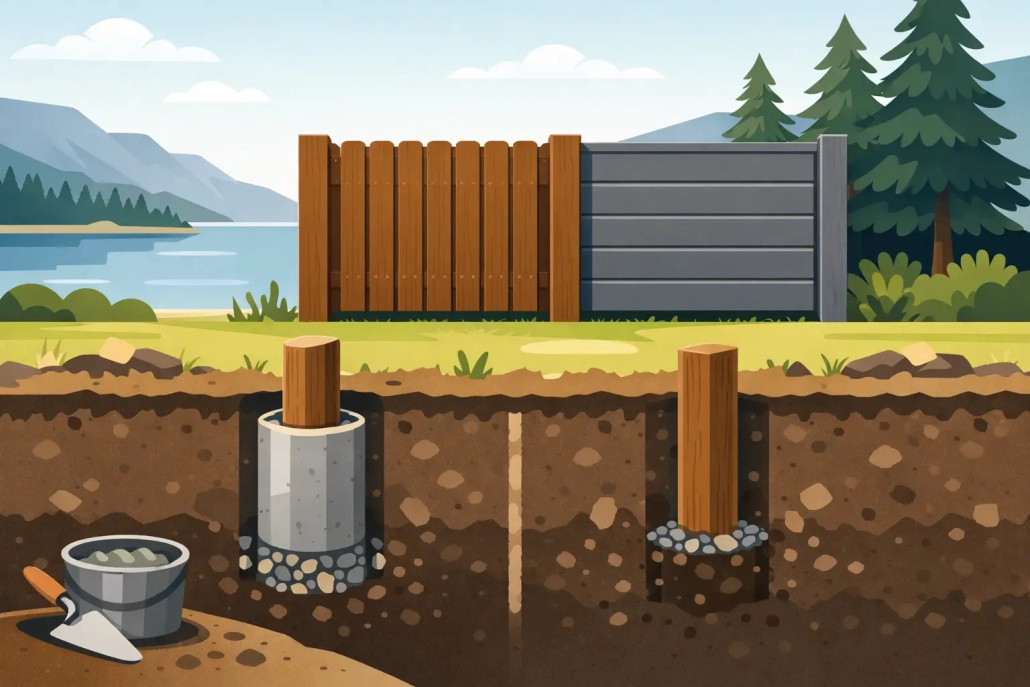
Concrete provides a firm base around a fence post. It helps resist movement caused by wind load, loose soil, gates, and the everyday pressure placed on a fence line. For many residential and commercial projects, concrete-set posts are the most dependable option.
A tall solid-panel fence is a common example. Cedar privacy fencing catches a great deal of wind, especially along open lots and properties near the water. Each panel acts like a sail. Concrete gives the posts the support needed to handle that load without gradually shifting or racking out of line.
Concrete is also a strong choice for gate posts. Gates put far more stress on posts than a standard fence section. Every opening and closing cycle pulls on the hinges, and a wide vehicle gate adds substantial leverage. A properly sized concrete footing helps keep the gate level, prevents sagging, and reduces the chance of latches drifting out of alignment.
Commercial fencing, ornamental fencing, and many chain link applications also benefit from concrete. Security fences need stable terminal posts and corners. Chain link tension places continuous force on those posts, while ornamental panels require accurate spacing and level installation. Concrete gives installers a reliable way to lock critical posts into position.
Do fences require concrete footings in every yard?
No. Some fences perform well with driven posts or posts installed in compacted gravel, provided the design and soil conditions support that approach. This is especially true for lighter-duty wire fencing, temporary enclosures, and certain agricultural or rural fence systems.
Driven steel posts are frequently used for deer fencing and wire fencing on large properties. They can be efficient, durable, and practical where the fence needs to cover long distances. The key is using the correct post type, embedment depth, spacing, bracing, and tensioning system. A fence is only as strong as its corners, ends, and gates, so those locations may still need concrete or substantial bracing even when line posts do not.
Gravel is another option in selected situations. It can provide drainage around a wood post and allow for careful compaction as the hole is backfilled. This approach is not a shortcut. The hole must be properly sized, the post must be straight and braced during installation, and the gravel must be placed and compacted in lifts. In poor soil or high-wind locations, gravel alone may not provide the holding power the fence needs.
The right question is not whether every fence needs concrete. It is whether the post system can safely carry the loads it will face over time.
Concrete is not a cure for poor drainage
There is a common belief that more concrete automatically means a longer-lasting fence. That is not always true, particularly with wood posts. If water is allowed to sit around the post, moisture can contribute to rot near ground level, where posts are most vulnerable.
The installation details matter. A footing should be sized for the post and the load. The hole should extend below the depth where seasonal ground movement is most likely to affect it. The top of the concrete should be shaped to shed water away from the post rather than forming a flat pocket where water can collect.
Post material also matters. Pressure-treated wood, cedar, galvanized steel, and aluminum all behave differently in wet conditions. Cedar is valued for its natural appearance and resistance to decay, but it still needs proper installation. Steel posts provide excellent strength for many fence systems, while concrete-set steel can be especially useful where a clean, long-lasting privacy fence is the goal.
Good drainage around the whole fence line is just as important as the footing itself. If a yard holds water after heavy rain, the site may need a different approach before the fence goes in. Ignoring drainage can lead to post movement, surface heaving, rot, and uneven panels regardless of how much concrete is used.
Site conditions that change the footing plan
Vancouver Island properties are rarely identical from one block to the next. A straightforward backyard in Nanaimo may have workable soil, while a nearby lot has shallow rock, clay, fill, or a steep grade. In Campbell River, Courtenay, Comox, Parksville, and Qualicum Beach, installers regularly encounter site conditions that call for a customized plan.
Rock is one of the clearest examples. When a post location hits bedrock, digging a standard hole may not be possible. The solution could involve jackhammering, drilling into rock, setting a post in a drilled socket, or changing the fence layout to work with the site. The right option depends on the fence type and the structural demand at that point.
Sloped properties need added attention as well. Posts may need to be longer on the downhill side, and fence sections may be stepped or racked to follow the grade. Concrete can help stabilize posts on a slope, but correct layout is what keeps the finished fence looking intentional rather than uneven.
Soil is equally important. Loose fill and sandy ground may require deeper holes or larger footings. Dense clay can hold water and create drainage concerns. A property exposed to prevailing wind may need closer post spacing, stronger rails, and more substantial end and corner assemblies. These are not extras. They are the difference between a fence that stands straight and one that becomes a repair job.
Footing depth and size depend on the fence
There is no single hole size that works for every fence. A short decorative border has different requirements than a six-foot cedar privacy fence or an eight-foot deer enclosure. Fence height, panel style, post size, soil type, local wind exposure, and gate placement all affect footing design.
As a general rule, posts need enough depth below grade to resist lateral movement. Larger posts and deeper footings are often required at corners, ends, transitions, and gate openings. Those locations carry concentrated forces from fence tension, changing directions, and moving hardware.
For a wood privacy fence, it is also worth considering steel post systems. They can improve long-term structural strength while allowing cedar boards and rails to deliver the warm, finished look many homeowners want. For chain link or wire fencing, properly braced terminals are often more important than adding concrete to every line post.
A professional installation should account for the full fence system, not just the hole beneath each post. Rails, fasteners, post spacing, panel construction, grade changes, and gates all work together.
Signs your existing fence may have footing problems
Leaning posts are the most obvious warning sign, but they are not the only one. A gate that drags, a latch that no longer lines up, panels that slope, or fence sections that shift after wet weather can all point to movement below grade.
Sometimes the issue is a failed footing. Other times, the post has rotted, the soil has washed out, or the original fence was not built with enough depth or bracing. Repairing one loose post may solve a small localized problem. If several posts are moving, however, the fence may need a more complete assessment before money is spent on repeated patch repairs.
Vancouver Island Fence Company approaches each project based on what the site and fence actually require. From standard residential cedar fencing to difficult drilling, heavy-duty commercial work, and custom rural enclosures, the footing plan should support the finished fence for years to come.
Before choosing concrete, gravel, driven posts, or a drilled installation, look at the fence as a working structure. Consider the ground beneath it, the wind around it, and the pressure it will carry. That practical planning gives you a fence that stays straight, functions properly, and continues to add value to the property.

