
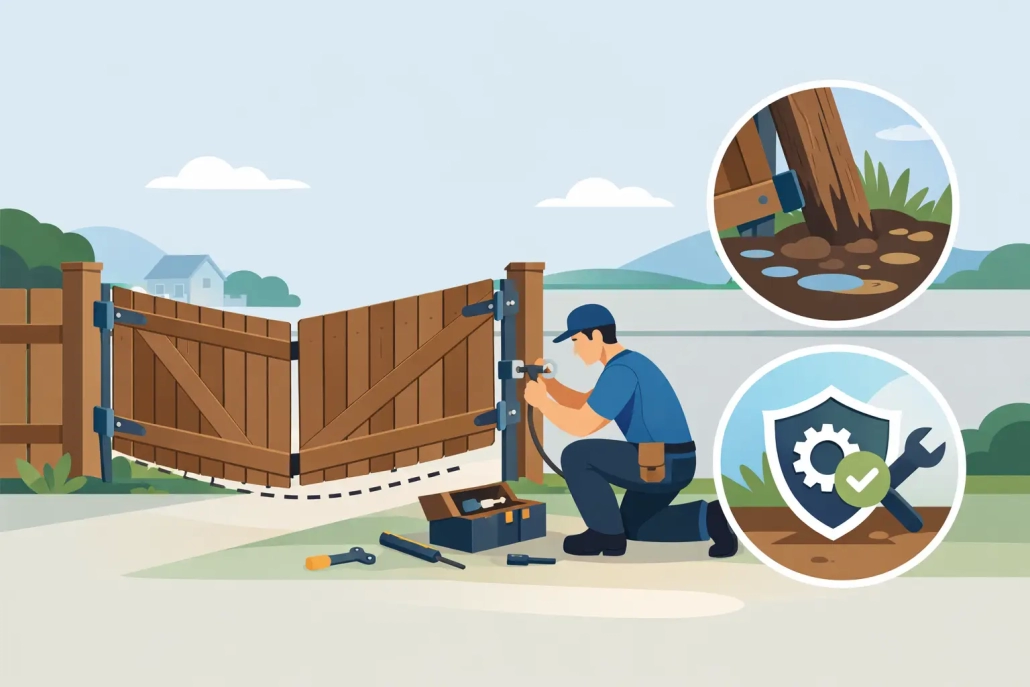
Gate Sagging: Causes, Repairs, and Prevention
A gate that drags across the ground, will not latch, or needs to be lifted every time it closes is not just an annoyance. Gate sagging is a structural warning that the gate, its posts, or the hardware is no longer carrying weight as intended. Left alone, a small alignment issue can turn into damaged hinges, a broken latch, loose fence panels, and a gate that no longer provides security or containment.
On Vancouver Island, wet weather, shifting ground, heavy use, and undersized construction can all contribute. The right repair depends on where the movement began. Sometimes a hinge adjustment is enough. Other times, the only lasting fix is rebuilding the gate or resetting the supporting posts.
What Causes Gate Sagging?
Most gates sag for one simple reason: their weight is pulling down on the latch-side corner. A properly built gate transfers that force back toward the hinge-side post. When the frame, hinges, post, or footing cannot resist that force, the gate gradually drops out of square.
The symptoms often show up in stages. The latch becomes difficult to line up. A once-even gap beneath the gate narrows on one side. The top latch-side corner moves downward while the opposite lower corner rises. Eventually, the gate catches on gravel, pavement, or grass and must be lifted to close.
Weak or undersized gate posts
A gate is only as reliable as the posts holding it. Gate posts carry more load than standard line posts, especially on wide driveway gates, tall privacy gates, or gates built with solid cedar boards. If the posts are too small, set too shallow, or installed without enough concrete support, they can lean toward the opening.
This is common when a gate has been added to an existing fence without upgrading the posts. A standard fence post may be suitable for supporting fence sections, but it is not automatically strong enough to carry a swinging gate. On wet or soft ground, the problem can develop faster as soil shifts around the post base.
A leaning post cannot be corrected by adjusting the latch alone. The post needs to be assessed for movement, rot, cracking, or a failed footing. In many cases, resetting or replacing the post is the only repair that will hold.
A gate frame built without proper bracing
Wood gates need diagonal bracing to keep their rectangular frame from becoming a parallelogram. The correct brace generally runs from the lower hinge-side corner up to the upper latch-side corner. This diagonal works in compression and helps transfer the gate’s weight back to the hinge side.
A brace installed in the opposite direction may look similar, but it does not support the load properly. Light-duty corner brackets alone may also be insufficient for a large, heavy gate. As boards swell and dry over changing seasons, weak joints can loosen and allow the frame to rack.
Metal gates can sag as well. Tubular steel frames may twist, welds can fatigue, or a frame can be too light for the mesh, slats, wood infill, or privacy material attached to it. Adding decorative elements after installation can also overload a gate that was originally designed for a lighter finish.
Loose, worn, or incorrectly placed hinges
Hinges are often blamed first, and sometimes they are the issue. Loose screws, pulled lag bolts, rusted hardware, bent straps, or worn hinge pins can all cause a gate to drop. On wood posts, repeated movement may enlarge the bolt holes until the hardware no longer sits tight.
Hinge placement matters too. Widely spaced hinges provide better support because they spread the load over more of the post and gate frame. Heavy gates may need three hinges or heavy-duty adjustable hinges. If the hinges are undersized or attached only to thin framing material, replacing a latch or adding a cable will not solve the underlying problem.
Water, rot, and ground movement
Vancouver Island properties deal with extended wet periods, and water finds weak points quickly. Cedar is a durable fencing material, but no wood post lasts forever when drainage is poor or the base remains saturated. Rot can begin near ground level where it is difficult to spot until the post starts moving.
Soil conditions also matter. Clay-heavy ground can expand and contract. Sloped properties can place uneven pressure on posts. In rocky areas, installation may require drilling, jackhammering, or specialized site preparation to establish a secure footing. A post that was forced into a shallow hole around rock may hold for a while, then start to shift under the weight of the gate.
How to Diagnose a Sagging Gate Before Repairing It
Start by opening and closing the gate slowly. Watch the gap between the gate and the ground, then check whether the latch aligns with the strike. A gate that has dropped evenly may point to hinge wear. A gate that is lower on the latch side and visibly out of square usually has a bracing or frame issue.
Next, inspect the hinge-side post. Stand behind it and look down its length to see whether it is leaning. Push gently on the post and watch for movement at ground level. Any noticeable movement is a sign that the footing, soil, or post itself needs attention.
Check the gate frame by measuring diagonally from corner to corner. On a square gate, both diagonal measurements should be close to equal. If one diagonal is longer, the frame has racked. Also look for split rails, loose fasteners, soft wood, cracked welds, and screws that have pulled free.
Finally, consider the gate’s history. Did the issue appear after a winter storm, a vehicle bumped it, new boards were added, or the property was regraded? Those details help identify whether the repair should focus on hardware, structure, or ground support.
When a Simple Adjustment Can Fix Gate Sagging
Minor gate sagging can sometimes be corrected without a full rebuild. Adjustable hinges can raise a gate when the posts are solid and the frame remains square. Tightening or replacing loose bolts may restore proper alignment. A worn latch can be repositioned once the gate itself is level.
For a wood gate with sound posts and a slightly racked frame, an anti-sag kit or properly installed diagonal cable can be useful. The cable should run from the upper hinge-side corner to the lower latch-side corner, allowing tension to lift the sagging side. This approach works best as a correction for a light or moderately sized gate with otherwise healthy framing.
These repairs have limits. A cable cannot straighten a rotted post, repair a fractured frame, or compensate for a gate that is simply too heavy for its support system. It may also hide the problem temporarily while stress continues to build in the hinges and post.
When Rebuilding Is the Better Investment
Rebuilding is usually the smarter choice when posts are leaning, wood is decayed, a gate has been patched repeatedly, or the opening is too wide for a single leaf gate. A new gate built around the correct frame size, bracing pattern, hardware, and post depth will operate more reliably and protect the rest of the fence from unnecessary strain.
For wide vehicle access, a double gate can reduce the load carried by each leaf. In some locations, a sliding or rolling gate may be a better fit than a large swinging gate, particularly where grade, wind exposure, or frequent vehicle access makes a swing gate difficult to manage. The right choice depends on the available space, surface conditions, and how the entrance is used.
Commercial, acreage, and animal-control gates require additional planning. A chain link, wire, or deer fence gate may need reinforced terminal posts and heavier hinges to withstand regular use. Privacy gates built with solid cedar panels need enough structural support to handle both weight and wind. A gate that performs well at installation should still have capacity for years of seasonal movement and daily use.
Preventing Gate Sagging in a New Fence Project
The best time to prevent sagging is before the gate is built. That starts with treating the gate opening as a structural part of the fence, not an afterthought. Gate posts should be selected for the size and weight of the finished gate, installed at an appropriate depth, and secured according to the soil and site conditions.
The gate frame should be designed for its span and material. Wider openings, taller gates, solid privacy panels, and heavy ornamental components all require stronger framing and hardware. Good clearance below the gate is also essential. Too little clearance may cause dragging after normal seasonal movement; too much can reduce containment for pets or livestock.
Regular maintenance helps extend service life. Check hinges and fasteners each season, keep vegetation from holding moisture against posts, and address latch alignment early. If a gate begins to drag, do not keep forcing it shut. That added pressure can turn a straightforward repair into a post replacement.
A gate should close cleanly, latch without lifting, and hold its line without extra support. If yours does not, Vancouver Island Fence Company can assess the posts, hardware, framing, and site conditions to recommend a repair that makes sense for the fence you have and the way you use it. A properly supported gate is a small detail that makes the whole property work better every day.

